sales@dhundairytech.com | +91 8200673508

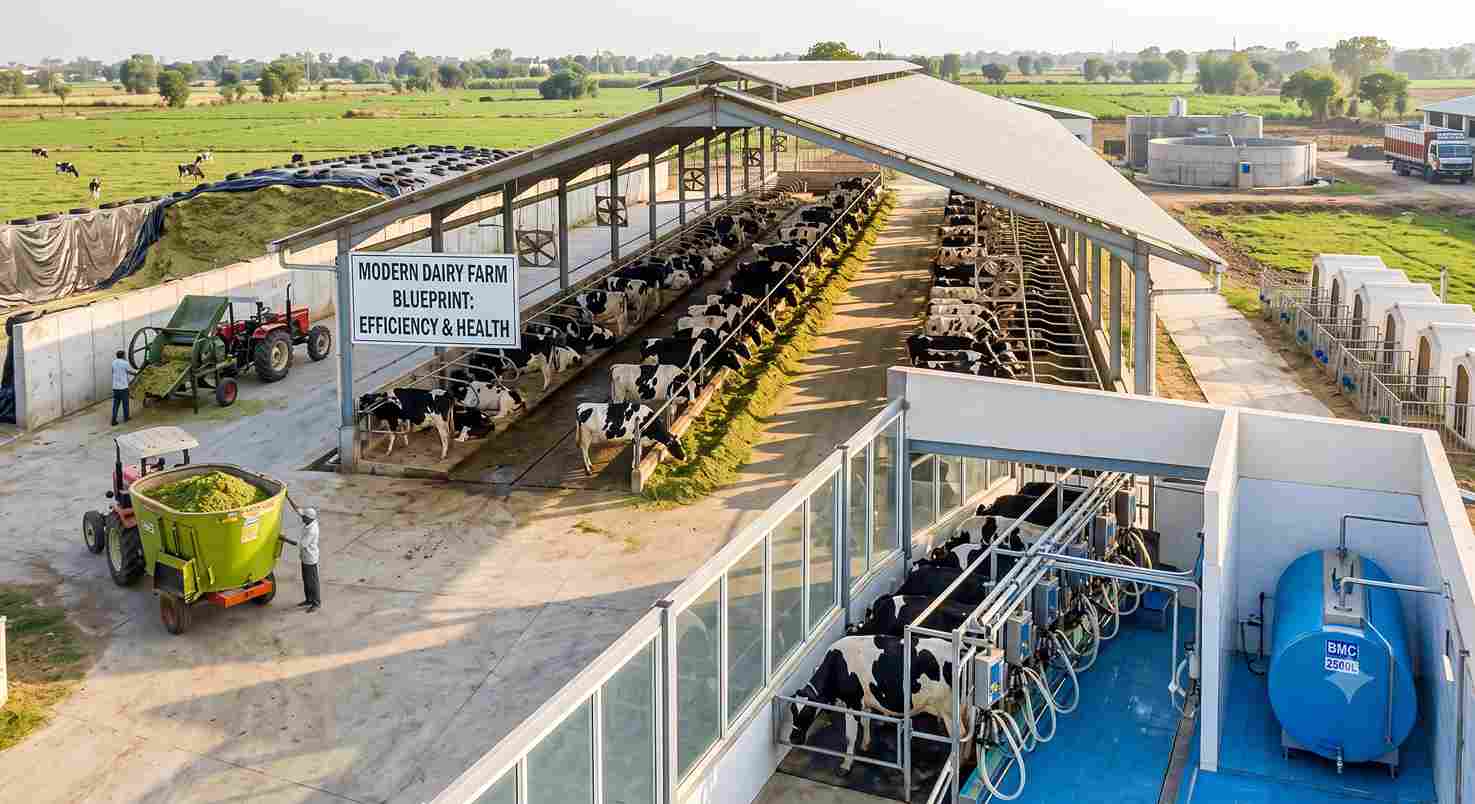
How to Set Up a Modern, Profitable Dairy Farm: The Ultimate Step-by-Step Blueprint

The commercial dairy industry is undergoing a massive shift toward precision automation, sustainable herd health, and scientific farm infrastructure. Transitioning from traditional, labor-heavy dairying to a modern commercial operation is one of the most effective ways to lower operational overheads, eliminate labor bottlenecks, prevent herd disease, and maximize milk yield per cow.
Setting up a profitable dairy unit requires a structured, data-backed approach. This comprehensive guide details every stage of establishing a high-performing dairy farm—from shed engineering and breed selection to farm automation, nutrition management, and disease biosecurity.
1. Farm Site Selection & Strategic Infrastructure Planning
Farm layout directly governs animal welfare, labor efficiency, and disease transmission. Poor shed ventilation or improper drainage can trigger chronic mastitis outbreaks, high somatic cell counts (SCC), and severe hoof lameness.
Ideal Site Selection Criteria
- Elevation & Natural Drainage: Choose elevated, dry land with good soil absorption. Avoid flood-prone lowlands.
- Biosecurity Buffer: Maintain a minimum perimeter distance of 500 meters from other livestock operations to minimize airborne pathogen transmission.
- Reliable Utilities: Ensure year-round access to clean, potable water (a single lactating cow consumes up to 100–120 liters daily) and a stable, high-phase electrical supply.
- Logistics Access: Easy connectivity to milk collection routes, veterinary services, and green fodder supply chains.
Explore our long liners for milking machines designed for efficient and hygienic milking.
Barn Orientation & Shed Engineering
- Orientation: Always align the shed along an East-to-West axis. This minimizes direct sunlight exposure inside the shed during the hottest afternoon hours while maximizing natural crosswinds.
- Ceiling Height & Roof Slope: Build shed heights of 12 to 14 feet at the eaves and 16 to 18 feet at the ridge using reflective roofing sheets (such as sandwich PUF panels or insulated Galvalume). A 25–30% roof pitch with an open ridge vent allows hot air to escape via the stack effect.
- Flooring Specifications: Concrete flooring should have a non-slip, grooved diamond pattern (grooves 10 mm deep, 100 mm apart) with a consistent 1.5% to 2% gradient leading directly toward covered slurry gutters. Slippery floors increase injury rates and inhibit heat detection behaviors.
       +------------------- 16-18 ft Ridge (Ventilated) -------------------+
      /                                                                     \
     /                                                                       \
    /  12-14 ft Eave                                             12-14 ft Eave\
   +---------------------------------------------------------------------------+
   |   Open Paddock Area   |   Feed Alley / Manger   |   Free-Stalls / Cubicles|
   |   (80-100 sq ft/cow)  |    (3 ft wide / cow)    |     (40-50 sq ft/cow)   |
   +---------------------------------------------------------------------------+
   |============== Slope (1.5% - 2%) ====> Drainage Gutter ====================|
Loose Housing vs. Free-Stall Cubicle Design
For modern herds, the Loose Housing System with Open Paddocks or Free-Stall Cubicle Barns outperforms tied/stanchion barns:
- Covered Resting Area: 40 to 50 sq. ft. per adult animal.
- Open Exercise Paddock: 80 to 100 sq. ft. per animal, ideally surfaced with soft sand or compacted earth.
- Feeding Manger Length: 2.5 to 3 linear feet of feed face per cow to avoid dominant animals crowding out younger or timid heifers.
Pair your 25L milking bucket with a reliable milking claw for efficient milk transfer.
2. Breed Selection & Herd Strategy
Matching the right breed to your regional climate, feeding capabilities, and target revenue model (volume-based vs. fat/solid-not-fat pricing) is the foundation of farm profitability.
| Breed Category | Top Breeds | Average Daily Yield | Milk Composition | Best Operating Environment |
| High-Yield Exotics & Crossbreds | Holstein Friesian (HF), Jersey, HF-Cross | 20 – 35 Liters | 3.5 – 4.0% Fat 8.5% SNF | Moderate climates; farms with active cooling systems (fans/misters) |
| Indigenous (Desi) Dairy Breeds | Gir, Sahiwal, Red Sindhi, Tharparkar | 10 – 16 Liters | 4.5 – 5.5% Fat A2 Beta-Casein | High-heat, humid regions; premium retail A2 milk branding |
| Commercial Riverine Buffaloes | Murrah, Jaffarabadi, Mehsana, Nili-Ravi | 12 – 18 Liters | 7.0 – 8.5% Fat 9.0% SNF | Local markets prioritizing high-fat milk, ghee, and paneer processing |
Buying Guidelines for Initial Herd
- Purchase cows in their first or second lactation, roughly 15 to 30 days post-calving, with calves at foot. This allows immediate milk revenue and direct verification of daily yield.
- Review documented pedigree records, artificial insemination (AI) histories, and previous somatic cell count data when sourcing from commercial breeding stations.
- Mandate pre-purchase veterinary screening for Brucellosis, Tuberculosis (TB), Johne’s Disease (JD), and sub-clinical mastitis via California Mastitis Test (CMT).
3. Essential Farm Automation & Milking Machinery
Manual hand milking is inconsistent, labor-dependent, and prone to cross-contamination. Automated dairy machinery ensures rapid, hygienic milk extraction while protecting teat tissue integrity.
       +-------------------------------------------------------------+
       |                  Central Vacuum Power Pump                  |
       +------------------------------+------------------------------+
                                      |
                       +--------------+--------------+
                       |                             |
             +---------v---------+         +---------v---------+
             | Pneumatic/Electric|         | High-Flow Milking |
             | Pulsator (60:40)  |         | Claw (240-350cc)  |
             +---------+---------+         +---------+---------+
                       |                             |
                       +--------------+--------------+
                                      |
                     +----------------v----------------+
                     | Food-Grade Silicone Teat Liners |
                     +----------------+----------------+
                                      |
                     +----------------v----------------+
                     | Direct-to-Can / Pipe Collection |
                     +----------------+----------------+
                                      |
                     +----------------v----------------+
                     | Bulk Milk Cooler (Cooled to 4°C)|
                     +---------------------------------+
1. Milking Systems
- Piston vs. Oil-Lubricated Vacuum Pumps: For units up to 10–20 cows, heavy-duty oil-lubricated or dry vacuum trolley systems provide stable, pulse-free vacuum levels (42 to 48 kPa for cattle; 48 to 50 kPa for buffaloes).
- Milking Claws & Pulsators: Utilize large-capacity claws (240cc to 350cc) paired with pneumatic or electronic pulsators set at a 60:40 milk-to-rest pulsation ratio (55–60 pulses per minute). This prevents teat-end congestion and hyperkeratosis.
- Silicone vs. Rubber Liners: Food-grade silicone liners last longer (up to 3,000–5,000 milkings versus 1,000 for standard black rubber), offer superior elasticity, and minimize teat sphincter trauma.
2. Post-Harvest Milk Chilling
Milk leaves the udder at ~37°C, an ideal temperature for rapid bacterial proliferation.
- Install a Direct Expansion Bulk Milk Cooler (BMC) sized to store two days of peak production.
- Rapid chilling brings raw milk down to 4°C within 2 to 3 hours of collection, preserving natural milk quality, preventing acidification, and earning top-tier quality premiums from processing dairies.
3. Feed & Fodder Processing Equipment
- High-Capacity Chaff Cutters: Dual-to-four blade motorized cutters (3–5 HP) chop green and dry fodder to 1.5 to 2.5 cm lengths, preventing selective feeding and increasing rumen digestion efficiency.
- TMR (Total Mixed Ration) Mixers: For herds over 30 cows, vertical or horizontal TMR wagons blend roughage, silage, grains, and mineral premixes into a uniform ration.
4. Scientific Nutrition & Feeding Management
Feed and fodder make up 65% to 70% of a dairy farm’s recurring operating cost. Formulating a consistent Total Mixed Ration (TMR) prevents metabolic disorders such as sub-acute ruminal acidosis (SARA) and ketosis.
       +-------------------------------------------------------------+
       |                Daily Dry Matter Intake (DMI)                |
       |                (3.0% - 3.5% of Body Weight)                 |
       +------------------------------+------------------------------+
                                      |
           +--------------------------+--------------------------+
           |                                                     |
+----------v-----------+                              +----------v-----------+
|   Roughage Fraction  |                              | Concentrate Fraction |
|     (60% of DMI)     |                              |     (40% of DMI)     |
+----------+-----------+                              +----------+-----------+
           |                                                     |
     +-----+-----+                                         +-----+-----+
     |           |                                         |           |
+----v----+ +----v----+                               +----v----+ +----v----+
|  Green  | |   Dry   |                               |  Energy | | Mineral |
| Fodder  | | Fodder  |                               | Protein | | Premix  |
|(25-35kg)| | (4-6kg) |                               | Grains  | | & Buffers|
+---------+ +---------+                               +---------+ +---------+
Dry Matter Intake (DMI) Calculation
- High-yielding dairy cows require a daily Dry Matter Intake equal to 3.0% to 3.5% of their total body weight (a 500 kg cow needs ~15–17.5 kg of dry matter daily).
- Roughage to Concentrate Ratio: Maintain a 60:40 ratio for lactating cows to balance rumen fermentation and milk solids production.
Daily Ration Components for an Adult Milking Cow
- Green Fodder (Roughage): 25 to 35 kg/day. Combine legumes (Alfalfa, Lucerne, Berseem, Cowpea) with non-legumes (Silage Corn, Hybrid Napier, Sorghum) to supply carotene and crude protein.
- Dry Roughage: 4 to 6 kg/day of clean wheat straw, paddy straw, or Rhodes grass hay to provide effective neutral detergent fiber (eNDF) for rumination.
- Concentrate Formulation: Feed 1 kg of balanced concentrate pellets (20–22% Crude Protein, 70% Total Digestible Nutrients) for every 2.5 to 3.0 liters of milk yielded, plus a 1.5 kg baseline for bodily maintenance.
- Vitamins & Minerals: Supplement 100 to 150 grams of chelated mineral mixture, 50 grams of sodium bicarbonate (rumen buffer), and salt daily.
Explore our milking machine pulsators for consistent pulsation during the milking process.
5. Heat Stress Mitigation (THI Optimization)
High ambient temperatures combined with humidity create heat stress, causing milk yields to decline by 15% to 30% while reducing breeding conception rates.
Keep the Temperature-Humidity Index (THI) below 72 using an integrated barn cooling system:
- High-Volume Low-Speed (HVLS) Fans: Install 16-to-24-foot HVLS fans along feed lines to maintain continuous air movement (2.5 to 3.0 meters/second).
- Cyclic Misting / Soaking Systems: Position automated low-pressure water sprinklers directly over cows at the feeding line. Run a 3-minute soaking cycle followed by a 12-minute fan drying cycle during peak temperature windows.
- Cool Drinking Water: Ensure continuous access to shaded, cool water troughs. A heat-stressed cow increases water intake up to 150+ liters daily.
6. Daily Milking Protocols & Biosecurity Hygiene
A standardized milking routine protects udder health and keeps bacterial contamination low.
The 5-Step Milking Procedure
- Pre-Stripping: Strip 2–3 streams of foremilk from each quarter onto a strip cup to check for clots or discoloration and stimulate natural oxytocin release.
- Pre-Dipping: Dip teats in a 0.5% available iodine or chlorine dioxide solution using a non-return teat dip cup. Allow 30 seconds of contact time.
- Drying: Thoroughly dry each teat with an individual single-use paper towel or sterilized microfiber cloth. Never cross-wipe between animals.
- Cluster Attachment: Attach milking teat cups within 60 to 90 seconds of initial udder stimulation to capitalize on peak oxytocin levels. Ensure clusters hang evenly without twisting.
- Post-Milking Teat Dipping: Immediately apply a viscous, barrier-forming post-dip (1% iodine with skin emollients) covering the bottom two-thirds of each teat. Keep cows standing at the feed fence for at least 30 minutes post-milking while teat sphincters close.
7. Preventive Herd Healthcare & Vaccination Schedule
A strict health calendar prevents production disruptions and keeps veterinary treatment costs low.
| Target Disease | Frequency / Timing | Target Group | Preventive Action |
| Foot-and-Mouth Disease (FMD) | Bi-annually (Pre-Monsoon & Post-Monsoon) | All animals above 4 months | Inactivated oil-adjuvanted vaccine |
| Hemorrhagic Septicemia (HS) | Annually (May / June) | All cattle & buffaloes | Alum-precipitated vaccine |
| Black Quarter (BQ) | Annually (May / June) | Young cattle (6 months to 2 years) | Polyvalent bacterin vaccine |
| Brucellosis (Strain 19 / RB51) | Once in a lifetime | Female calves (4 to 8 months only) | Live attenuated calfhood vaccine |
| Parasitic Deworming | 3 to 4 times yearly (Rotational) | Whole herd; 15 days pre-calving | Broad-spectrum anthelmintics (Fenbendazole, Ivermectin, Oxyclozanide) |
8. Financial Roadmap: 10-Cow Commercial Startup
A structured 10-cow high-yield model highlights the primary capital costs and revenue drivers of a modern setup:
+-----------------------------------------------------------------------------+
|                 ESTIMATED CAPITAL EXPENDITURE (CAPEX)                       |
+---------------------------------------------------+-------------------------+
| Category                                          | Proportion of Total     |
+---------------------------------------------------+-------------------------+
| Quality Livestock (10 High-Yield Crossbred/HF)    | 50% - 55%               |
| Barn Fabrication, Concrete Flooring & Paddocks    | 25% - 30%               |
| Automation Machinery (Milking Units, BMC, Cutter) | 12% - 15%               |
| Water Storage, Biosecurity, Electrical & Misc     | 5% - 8%                 |
+---------------------------------------------------+-------------------------+
Operating Economics & Key Profit Drivers
- Calving Interval Management: Maintain a 12 to 14-month calving interval with a 60-day voluntary waiting period (VWP) to avoid long, unproductive dry periods.
- Manure & Bioproduct Monetization: Process farm manure through a vermicomposting unit or anaerobic biogas digester to generate organic fertilizer and replace grid power with biogas electricity.
- Calf Management: Rear female heifer calves on automated or hygienic bottle-feeding programs using quality colostrum within the first 2 hours of birth. Healthy heifers can reach their breeding weight (320–350 kg) by 14 to 16 months.
Frequently Asked Questions
How long does it take for a commercial dairy setup to break even?
Most well-managed modern dairy farms achieve operational break-even within 18 to 24 months, with full capital recovery typically achieved between years 3 and 5 depending on herd genetics, feed cost control, and milk marketing channels.
What is the ideal milking machine vacuum level?
Standard operating vacuum levels should sit between 42 and 48 kPa (12.5–14.2 inHg) for crossbred dairy cattle and 48 to 50 kPa (14.2–14.8 inHg) for riverine buffaloes, operating with a balanced 60:40 pulsation ratio.
How much silage should be prepared per cow annually?
A milking cow fed 15–20 kg of silage daily consumes roughly 5.5 to 7.0 metric tons of silage per year. Plan pit or bunker silos with a 15% buffer to account for packing and fermentation losses.